
Elvina Mamadjanova
Before exploring the importance of Uzbekistan’s accession to the World Trade Organization (WTO) for the political economy, it is necessary to conduct an analysis of the economic transformation that the country was undergoing since 2017. The initial economic situation was characterized primarily by rigid state control, government intervention, restrictions on foreign currency exchange, and various barriers to foreign investment and trade. Uzbekistan had limited international economic and its economy remained relatively closed and poorly integrated into global markets.
Shavkat Mirziyoyev, the President of the Republic of Uzbekistan, took office in December 2016, and has already implemented a series of reforms aimed at transforming the existing economic model and opening the country to international markets. The reforms that gained progress in 2017, were actually a significant milestone toward a more market-oriented economy and closer international economic cooperation.
The Uzbek sum, national currency, was liberalized in September 2017 and became one of the most significant changes made. The reform standardized exchange rates and eased the restrictions on foreign currency conversion, allowing businesses and individuals both in Uzbekistan and overseas to conduct international payments and foreign exchange transactions more easily.
This regulation added to the significance of international trade as it reduced the barriers that companies encounter conducting cross-border transactions. Another important area of reform was the improvement of the investment climate. The government has introduced measures to attract foreign direct investment (FDI) including legal guaranties for investors, simplified business procedures and efforts to reduce administrative barriers.
According to the Center for Economic Research and Reforms (CERR), total attracted and utilized FDI and foreign loans in Uzbekistan reached $109 billion between 2021 and 2025, surging 4.3-fold to $38.4 billion in 2025 alone (“Infographic”). The changes aimed to stimulate the prosperity of the private sector and to broaden the role of foreign firms in the national economy. Uzbekistan is also working to gradually liberalize its foreign trade regime, reduce trade barriers, simplify customs procedures, and provide more opportunities for international business cooperation.
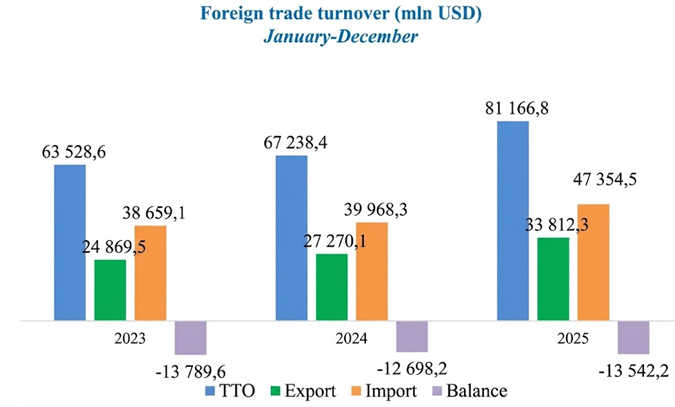
Figure 1.1. Dynamics of Uzbekistan’s Foreign Trade Turnover, Exports, Imports, and Trade Balance, January–December 2023–2025 (USD millions).
Source: National Statistics Committee of the Republic of Uzbekistan.
Figure 1.1. Illustrates the statistical data on the turnover of foreign trade, spanning the period of 2023, 2024, and 2025. The bar chart distinguishes between four different metrics: Total Trade Turnover (TTO), Export, Import, Balance. Overall, both exports and imports showcase substantial and steady growth during the observational period; total trade turnover (TTO) starting with 63,528.6 million dollars in 2023 witnessed an accelerated growth to 81,166.8 million dollars in 2025, which proves the theory that the government paid more attention to diversify its exports and build up economic relations with foreign partners.
After decades of limited engagement with global markets, these results show that Uzbekistan now views international economic integration as a key priority. Joining the World Trade Organization is the next logical step in this ongoing reform process. Beyond strengthening the country’s position in global trade, WTO membership requires aligning domestic laws and economic policies with established international rules.
Uzbekistan has been pursuing membership in the WTO for many years. The country first submitted an application for membership in 1994; however, the process was suspended in 2005 and subsequently resumed in 2018. Since then, the government has been making changes to national legislation and trade policy in order to bring them into line with WTO standards. Uzbekistan is expected to complete its accession process in 2026, the WTO reported (“Uzbekistan Steps Up”).
According to the 13th Working Party meeting in July 2026, reports indicated that 31 bilateral market access agreements had been concluded and that 190 laws had already been brought into adherence with WTO rules (“Working Party”). Trade rules, subsidies and state support for domestic industries are some of the issues yet to be addressed.
WTO accession can affect Uzbekistan’s economy through several channels. Firstly, lower trade barriers and more accessible trade regulations can increase exports and imports. Secondly, changes in trade regulations and greater transparency may indeed influence and attract foreign direct investment (FDI). Thirdly, the competition between local and foreign products will be increased, thus encouraging domestic companies to improve productivity and reduce production costs. Evidence from other countries supports these potential benefits.
WTO researchers looked at 150 economies in a 2024 study and found that countries pushing through major reforms during accession boosted their annual growth by an average of 1.5 percentage points (Brotto et al.). Not every country gets that kind of boost, though. Lowering trade barriers exposes local businesses to intense outside competition, which often leaves weaker firms struggling to stay afloat. For Uzbekistan, the real economic payoff will come down to how well the government backs its domestic businesses and pushes through structural changes alongside opening up trade.
The author is a third-year undergraduate student majoring in Economics at the American University of Central Asia and Bard College. Their academic interests include economic development, regional integration, and Central Asian affairs, with a particular focus on Uzbekistan’s ongoing economic transformation and its broader regional implications.