

Brigadier Saleem Qamar Butt, SI(M), (R)
This piece is a corollary to an earlier published column titled “Dangerous Denials”, which was published in December 2023 in remembrance of the greatest tragedy of Pakistan’s history i.e. Breakup of United Pakistan on 16 December 1971. Karl Marx said, “History repeats itself, first as tragedy, then as farce. If history repeats itself and the unexpected always happens, how incapable must man be of learning from experience?” On many counts, successive governments in Pakistan have been living in a consistent state of denial since inception. Consequently, the wicked cycle of history repeating itself with ugly and unexpected happenings has never ceased, with sham democracy by the corrupt rulers being the worst outcome. When people at the helm of affairs are confronted with this reality, their cynical response is tantamount to, “It’s not denial. I’m just selective about the reality I accept.”
What started as a denial of the Father of the Nation’s vision about the State of Pakistan’s concept with respect to the domestic, foreign, and defense policies and guidelines for the role of the state institutions has unfortunately kept multiplying the backlash. The mysteries and intrigues surrounding the demise of the Quaid-e-Azam Muhammad Ali Jinnah, the murders of Liaqat Ali Khan, Fatima Jinnah, Zulfiqar Ali Bhutto, General Zia-ul-Haq, Benazir Bhutto, and the murder attempts on former Prime Minister Imran Khan have been kept under wraps, and historical facts are obscured in a deliberately spread confusion. The dirty machination, which was set out by Iskander Mirza, has been used as a benchmark ever since. The overnight writing off all corruption and criminal charges of the previously vilified ruling elite and their startling quick enthronement, was accompanied by decimation of the ousted ruling party and incarceration of its leadership, which has kept the national stability on the boil since April 2022; the rest is all detail. Even the greatest tragedy of 16th December 1971 has not shaken the ruling club’s conscience to learn from the past blunders and take due measures to avoid the recurrence of such devious man-made disasters.
Unfortunately, the whole nation is haplessly experiencing the same old ‘Acerbic Environment’; people are exposed 24/7 to blistering hate speeches through print, electronic, and social media. The hired guns appearing on electronic media as journalists-turned-intellectuals, political advisers, and influencers have found the perfect bonanza. The war of flimsy narratives with a short lifespan is nevertheless causing abysmal mental trauma, societal disorientation, and disenchantment. Such putrid environs are exacerbating political polarisation in a country already confronted with serious internal and external security threats, grave economic challenges, and worst judicial crisis. The students of political history easily discern a lot of resemblance between the current national situation of 1958, 1970/71, 1974, 1977, 1993, and 1999. The powerful ruling elite in Pakistan needs to remember that “each time history repeats itself, the price goes up.”
In my column published in December 2020 titled “16th December: Pakistan’s Greatest Tragedy” and an updated piece republished in July 2024 titled “Déjà Vu or Karma?”, it was commented, “Those who cannot remember the past are condemned to repeat it.” Seeing the half glass full, Pakistan has made good progress in the roads infrastructure and the defence sector, especially as manifested by the recent iron-fist response to the unprovoked Indian aggression from the East and West. However, taking lessons from our own past, it must be capitalized by improving the internal situation with a focus on overcoming the greatest ‘National Weakness’ through long overdue ‘Indispensable Reconciliation’ rather than sprinkling oil on the raging fire; and the institutions must avoid falling victim to the political traps. In 1970–71, there was a power tussle between the PPP versus the Awami League involving the Armed Forces in an unenviable role, resulting in the emergence of Bangladesh. Since 2022 to date, it has been the PMLN plus PPP versus PTI (At the Brink), with two other main state organs operating almost in a similar manner. God forbid any further splintering.
Looking back at former East Pakistan, now Bangladesh, it is also satisfying to note that the tyrannical rule by former PM of Bangladesh, Sheikh Haseena Wajid, met its due fate, having been found guilty of massive plunder, maltreatment of political opponents, and crucifixion of stranded Bihari Muslims and of Jamiat-e-Islami. It is also a matter of succor that despite passing through a number of bloody coups instigated by India, Bangladesh has made good progress in many fields. One would hope that, as a lot of Pakistani citizens indulge in introspection and sincerely regret the greatest tragedy of Pakistan’s history, there might also be millions of people in Bangladesh who could now see the truth behind the Indian intrigues & propaganda, and have a similar yearning for lost brothers. If East and West Germany could be reunited in 1990 after 45 years of breakup, and North and South Koreans are coming closer, a day may be in store by Almighty ALLAH when Pakistan and Bangladesh could carve out a blueprint for reunion as ‘One Nation with Two States’. After all, the creation of Bangladesh was neither the negation of the two-nation theory nor the breakup of the Islamic brotherhood bond. It is reassuring and heart-warming to see the Bangladeshi people cheering Pakistani sports teams and vice versa all over the world. ‘May we never confuse honest dissent with disloyal subversion. ‘ Pakistan Zindabad!
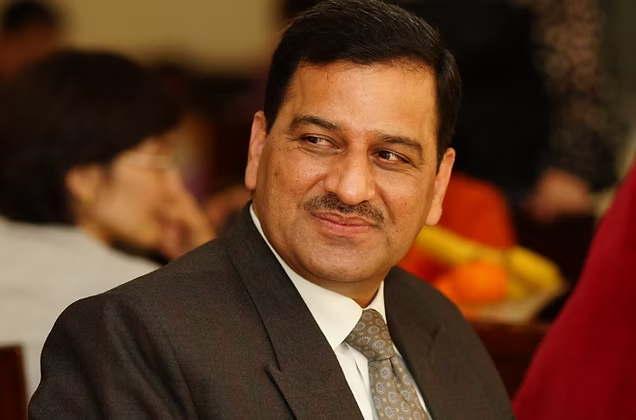
The author is a Geopolitical & Strategic Security Analyst. Appears on PTV News, AJ, RT, GNN & Express TV. Columnist for Daily "The Nation", "The Times", 'Business News', & 'South Asia Magazine'.