

Sabrina Mamadpanoeva
Few railways are simply infrastructure and rarely are their entire contours merely rails. Instead, railways shape trade, relationships, dependence, and terms between parties. Yet the CKU brings Kyrgyzstan, for the first time, a rail link to markets of consequence. A link, though, does not necessarily carry power. It is unlikely Kyrgyzstan will gain much unless it is able to appropriate goods at entry and exit points, where freight is processed, charged, and priced, when the infrastructure is in large part built and maintained by others, leading Kyrgyzstan to be a transit state, not simply a transit country.
The project is now under construction. The line will run 532.5 kilometres from Kashgar to Andijan, 305 of them in Kyrgyzstan, according to Railway Pro. The estimated cost is $4.7 billion, and about half comes as a 35-year Chinese loan to the joint project company. In that corporation China own 51%, Kyrgyzstan and Uzbekistan have 24.5% each. The first tunnel on the Kyrgyz section has already been completed, and the official target is 2030.
The argument for an improved transport infrastructure in Kyrgyzstan is clear. A significant proportion of Kyrgyzstan’s cargo remains part of the road transit through Uzbekistan and Turkmenistan. Rail is estimated to carry between 5-7 million tonnes annually, out of the 15 million tonnes expected, however annual rail freight across China and Kazakhstan alone exceeded 32 million tonnes in 2024. The Central Kyrgyzstan Union (CKU) is an important additional access to Central Asia – not a substitute for existing routes and using a route that avoids Russia and Kazakhstan increases the strategic importance of Bishkek and Tashkent. For this reason Kyrgyzstan’s own relative negotiating power may be at its height prior to the start of contracts and before traffic becomes smooth.
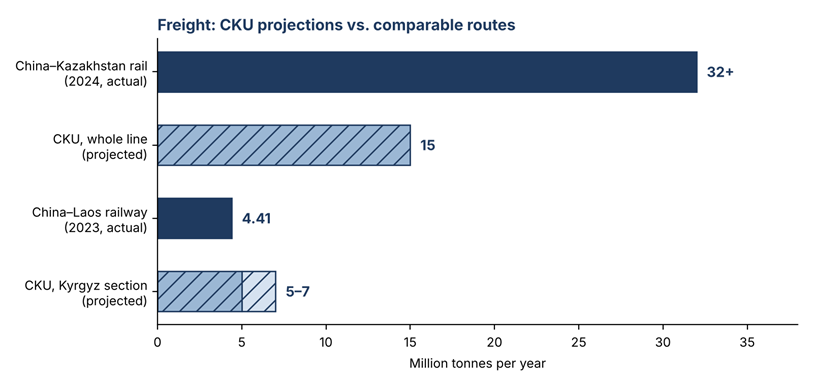
Figure 1. Freight volumes: CKU projections versus comparable routes (million tonnes per year). CKU figures are projections; the China–Kazakhstan figure is for 2024 and the China–Laos figure for 2023. Sources: Central Asia Program, Caspian Policy Center, NBR.
Thus, the railway is an example of a typical dilemma faced by small states. Kyrgyzstan needs foreign capital to offset its landlocked position, but this likely limits its ability to make autonomous choices. Supporters of foreign investment have a valid argument against this: Kyrgyzstan could not have built a railway of this nature on its own, and it may be possible that claims of a “debt trap” are simply exaggerated.
Evidence from Laos suggests otherwise: in the case of its railway built by China, the volume of freight crossing the border doubled in the period 2022-2023 from 2.1 million to 4.41 million tonnes, while China had put in more than $2.5 billion in debt payments. This indicates that a railway of this type can work, and it may be that both arguments are correct: the railway can generate profits and Kyrgyzstan can have little autonomy in its operation.
However Laos shows that there can also be too much optimism. By 2022 the country’s public debt had risen to 110 percent of gross domestic product (GDP), with roughly half of its external debt to China. The railway project had affected 6,855 families as of mid-2023. It should be noted that a working railway does not necessarily mean a sustainable budget. Kyrgyzstan faces a similar quandary. Its debt to China’s Eximbank reached nearly $1.5 billion by early 2026, with a further approval of a loan of $304.5 million to cover its portion of equity. Although the company’s debt and the state borrowing are two separate obligations, the two jointly increase the amount of revenue the country has to cover by the railway. A Kyrgyz government official estimates that even in a pessimistic scenario, the project might generate about $300 million a year, but this remains a forecast, not a revenue stream. .
The contrast between the financial side of a railway’s history and its operational side is best illustrated by the gauge problem. China uses a gauge of 1,435 mm, while Kyrgyzstan and Uzbekistan both use the Soviet gauge of 1,520 mm. Of interest is that part of Kyrgyzstan’s railroad will use the Chinese gauge while the dry port at Makmal will be used to transfer containers between the two systems. This arrangement carries significant consequences.
If the dry port at Makmal merely transfers freight, then Kyrgyzstan will receive a greater volume of traffic but the economic benefits will not necessarily accrue in Kyrgyzstan. If warehousing, customs processing and light processing activities are developed around the dry port, then part of the economic value of the added transport costs will remain in Kyrgyzstan. Experts have stressed that such industrial zones must develop into a real cluster of production, not just traffic handling facilities.
There are three concrete measures that should make project implementation more likely. Firstly, publication of the tariff structure and assumptions for the traffic to serve the debt will, for the first time, start to put a good face on the project. Under such circumstances the project can only gain credibility, which is vital for a project of such magnitude.
Secondly, minimum shares should be allocated to Kyrgyz contractors and workers and appropriate payment ensured, especially as the 214 houses planned to be demolished are more than three times larger than the current population of 60,000.
Third, the demarcation of a zone for Makmal and Jalal-Abad, with accompanying zoning regulations for processing and services, and some free access to alternative routes, could be required. One thing all these proposals have in common is that they can be measured, which cannot be said of such general reassurances that ‘joint benefit’ is promised and can be only too easily explained away.
And lastly, Tajikistan has endorsed a branch toward South Asia; a pilot container train has already successfully traveled from Lanzhou to Dushanbe and transited through Kyrgyzstan and Uzbekistan.
By 2030, either the railway will transit the Kyrgyz Republic on the way to other destinations, with goods flowing past empty warehouses and with a heavy debt burden incurred in the process, or the railway will support economic hubs and local jobs, and serve as an aid to exporting Kyrgyz goods. In both cases the same physical rails will be present. The deciding difference will be the agreements Bishkek makes before the first train arrives. For a country of its size, the main question is not whether to be engaged with Chinese capital, but at what terms-and that may be how we really get to judge the railroad.
Sabrina Mamadpanoeva is a young researcher and policy intern at PolicyEast. A graduate of the American University of Central Asia (AUCA) in Bishkek, she focuses on Central Asian connectivity, trade and regional security. Her work examines how infrastructure projects shape economic and strategic relations between small states and major powers, and the practical choices governments face when they borrow to build